DeFi — Ethereum — Restaking
Swell Network
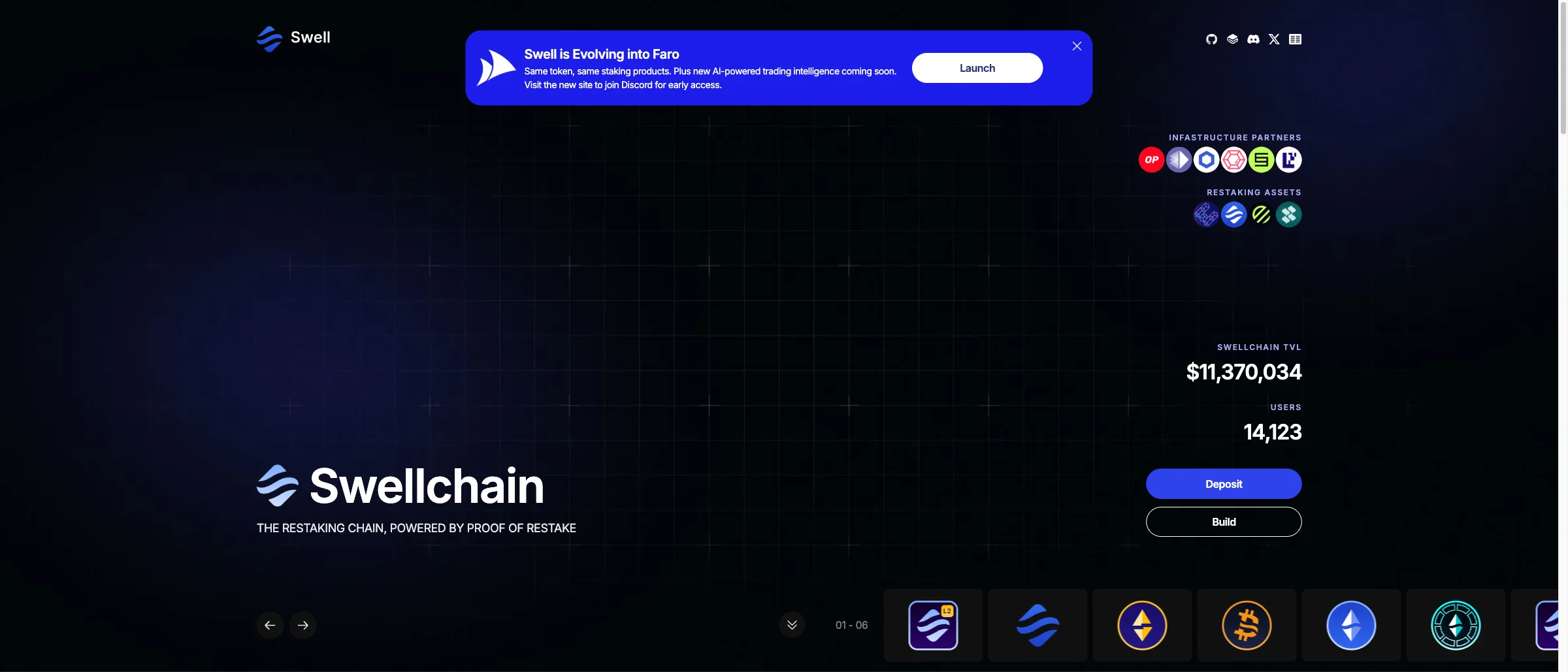
A liquid restaking and staking protocol enabling users to stake ETH and other assets while earning yields across multiple DeFi opportunities, secured by its Layer 2 blockchain Swellchain.
Read case study
DeFi is where smart contracts get financially consequential. The code doesn’t just execute logic — it moves real value. Bugs aren’t just bugs. They’re potential losses.
Engagement
Blockchain Engineering
Typical Duration
8 – 16 weeks
Focus & Stack
We build DeFi protocol infrastructure with the rigour it demands. Mathematical modelling before code, exhaustive testing, and architecture designed for the reality that these systems will be adversarially tested by people looking for exploits.
Single-asset and LP token staking. Fixed APY, dynamic APY, tiered rewards, compounding, multi-reward-token distribution, penalty periods, migration paths.
Linear, cliff-then-linear, milestone-based, custom schedules. Revocable and irrevocable, with governance integration so vesting tokens can vote.
ERC-4626 tokenised vaults. Strategy contracts, harvest mechanics, fee structures. Automated or governance-directed rebalancing.
Concentrated and full-range liquidity, custom bonding curves, specialised AMM designs for unique pricing requirements or restricted participant pools.
Merkle-based airdrops, streaming rewards, emissions schedules, retroactive distributions. Gas-efficient patterns for large recipient sets.
On-chain treasury with multisig governance, spending proposals, automatic diversification, accounting.
Token flow diagrams, reward formulas, scenario analysis, edge case identification. Spreadsheet models and Python simulations.
Token flow diagrams, reward formulas, scenario analysis, edge case identification. Spreadsheet models and Python simulations.
Contract system structure, interactions, storage layout, failure modes.
Contract system structure, interactions, storage layout, failure modes.
Solidity, following rigorous coding standards with 95%+ coverage.
Solidity, following rigorous coding standards with 95%+ coverage.
Invariant testing, fuzz testing, economic attack simulation, oracle security validation.
Invariant testing, fuzz testing, economic attack simulation, oracle security validation.
Audit preparation, external audit support, mainnet deployment with monitoring.
Audit preparation, external audit support, mainnet deployment with monitoring.
Deliverables
Stablecoins look simple from the outside and are anything but underneath. The token contract is the smallest part. The hard part is the issuance and redemption flow, the way the peg is held, the controls around mint and burn authority, and the integrations that decide whether the token has any real use beyond sitting in a wallet.
There are three peg models worth understanding before any code is written. Fiat-backed stablecoins hold reserves off-chain and lean on attestations and operational discipline rather than smart contract logic. Crypto-collateralised designs lock on-chain assets and use overcollateralisation, liquidation engines, and oracle feeds to keep the peg. Algorithmic designs try to hold the peg through supply mechanics alone, and most of them have failed in production. The choice is a commercial and regulatory one as much as a technical one.
On NZDD we built the core token contract logic for issuance, transfers, and lifecycle management on Ethereum, working to OpenZeppelin standards so the contract was clean to audit and clean to integrate against. Token rails on their own are not enough though. We did the DEX integration work to give NZDD live secondary liquidity, the wallet and dApp compatibility work to make it usable across the ecosystem, and the developer-facing documentation to lower the barrier for other teams building on top of it. That spread of work, contract through to ecosystem fit, is what determines whether a local-currency stablecoin gets used or just exists.
Cross-border use adds another layer. Local-currency stablecoins compete with established global ones, so utility has to be obvious. That usually means real DEX depth, predictable redemption, and integrations with the payments and DeFi venues users already touch. Decisions made at the contract level either support that or quietly close it off later.
Tokenising a real world asset is mostly a question of where the legal claim lives and how the on-chain representation stays in sync with it. The contract is one piece. The harder pieces are the off-chain custody, the redemption mechanics, the KYC and jurisdictional gates around who can hold the token, and the oracle or attestation layer that connects the on-chain state to the real asset.
On GrtWines we tokenised physical fine wine on Polygon, with custom Dyon smart contracts handling minting, ownership, transfers, and redemption across three NFT types: Standard Asset, Futures, and Pool. Each type carries different redemption rules tied to the lifecycle state of the underlying bottle, In the Field, In the Barrel, or In the Bottle. KYC is gated at the contract layer for new drops and physical redemption, with open marketplace access for secondary trading. A standalone Go orderbook handles real-time matching off-chain so the marketplace can run at proper throughput without bloating the contract layer. Producer royalties flow on every secondary trade, which is the kind of mechanic that only works cleanly when the contract design accounts for it from day one.
NZDD sits in the same RWA category from a different angle, the underlying asset is a fiat currency reserve rather than a physical good, but the same questions apply: who can mint, who can hold, how is the off-chain backing represented, and what happens at redemption. The answers shape the contract.
Fractionalisation, oracle dependencies, and regulatory fit are usually where RWA designs come apart. Fractionalisation only works if the legal structure supports partial ownership. Oracles only work if the data source is reliable and the failure mode is defined. Regulatory fit is jurisdictional and rarely solvable purely in code. We push these decisions to the front of the engagement so the contract design reflects them rather than working around them later.
A token generation event is one of the higher-stakes things a project ships. The launch contracts move significant value, the distribution mechanics shape the early holder base, and a lot of the decisions are difficult to reverse once tokens are in circulation. The work spans vesting schedules, allocation buckets, claim mechanics, listing readiness, and the operational tooling around it.
Vesting is where most projects underestimate the work. Linear, cliff-then-linear, and milestone-based schedules each have to be modelled against the cap table, the unlock cliffs, and the governance implications if vesting tokens vote. On Mandala Chain we built the token vesting claim wizard and the staking pools dashboard as part of a wider DeFi suite, integrated directly into the Mandala Hub through shared Wagmi and Polkadot wallet infrastructure. Vesting and staking flows handled significant funds, so the focus was on clean claim UX and contract behaviour that held up under scrutiny.
Distribution mechanics matter as much as vesting. We have worked across the Vana ecosystem on the user-owned data hub, including the integration layer that connects users into protocol services. That kind of consumer-facing surface is what determines whether a token launch actually reaches the intended audience or stalls at the technical layer. Pectra Staking Manager is a different angle on the same problem, a non-custodial tool we built with PierTwo and Hashlock for Ethereum validators to access EIP-7251 consolidation and EIP-7702 batching, abstracting raw contract interactions into a usable interface from launch day.
Common pitfalls are predictable. Vesting contracts that cannot be paused or migrated. Claim flows that expose users to MEV at the unlock cliff. Allocation logic that does not match the cap table once edge cases hit. Listing timing that runs ahead of liquidity readiness. None of these are exotic problems. They show up because the launch was treated as an event rather than an operational system, and we work the other way around.
6 projects as proof
Primary DeFi surface. Liquid staking, vaults, governance, stablecoin rails and validator-level tooling on Ethereum mainnet and EVM-compatible L2s.
1 project as proof
EVM L2 used for tokenisation-led DeFi where lower fees support consumer-facing flows — RWA marketplaces with secondary trading and producer royalties.
2 projects as proof
Substrate-based L1/L2 stacks. Full DeFi suites including DEX, lending, staking and vesting integrated through shared Wagmi and Polkadot wallet infrastructure.
FAQ
We’ve built DeFi protocols across staking, lending, swaps, vaults, and treasury management. Our engineers understand the financial models behind the code. That depth matters when real value is at stake.