DeFi — Yield — Vaults
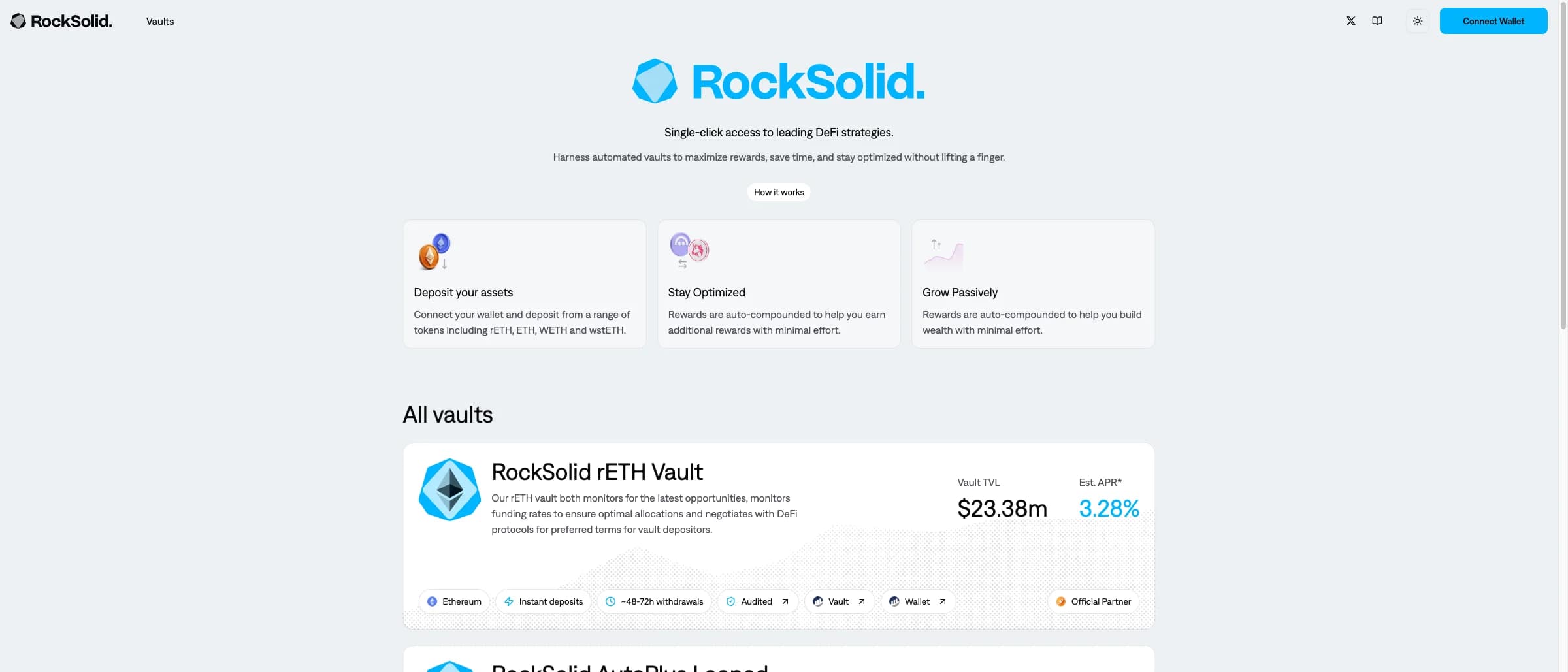
Rock Solid
An institutional-grade liquid vault platform giving single-click access to curated DeFi yield strategies through a clean, integration-ready app experience.
Read case study
Web3 integration means different things depending on who the user is. The challenge is building products that serve crypto-native and mainstream audiences well — sometimes both at once.
Engagement
Product Development
Typical Duration
6 – 12 weeks
Focus & Stack
We build applications where blockchain functionality is woven into the product experience, not bolted on as a feature checkbox. Whether that’s embedded wallets for mainstream users or full on-chain transparency for crypto natives, the integration is designed to serve the user, not showcase the technology. We’ve been building Web3 integrated products since the early days of dApp development, so when an abstraction layer breaks, we can debug at the protocol level, not just the SDK level.
RainbowKit, ConnectKit, Dynamic, or custom implementations. MetaMask, WalletConnect, Phantom for crypto natives. Privy, Dynamic, Web3Auth for mainstream users with embedded wallets.
ERC-4337 for non-crypto users. Gasless transactions, session keys, social recovery, batched operations. Users interact without seeing gas fees or managing seed phrases.
Access control based on on-chain holdings. Token balances, staking positions, governance participation, credential ownership, time-based conditions.
Purchasing, minting, staking, voting, claiming. Full transaction lifecycle with proper state handling, error recovery, and user feedback.
Wallet balances, token prices, transaction history, staking positions. Indexed, cached, and presented without overloading RPC endpoints.
Products across Ethereum, Polygon, Arbitrum, Base, Optimism, Solana. Unified experiences that abstract multi-chain complexity.
Deliverables
Most NFT work we get pulled into now is not about minting JPEGs. It is about wiring NFTs into a product that has to serve regular users, often alongside a regulated physical asset or a real commercial workflow. The integration questions become the hard part. Where does the wallet sit. How does someone who has never touched crypto buy or claim. What happens when the token represents something off-chain that has to be delivered, redeemed, or revoked.
GrtWines is a clean example. We built a full marketplace that tokenises physical fine wine on Polygon, with auction and fixed-price listings, a real-time Go orderbook for secondary trades, and KYC-gated drops for new releases. Wine collectors who are not crypto-native can sign up via standard Web2 auth and KYC, while crypto-native users connect a wallet directly. NFTs move through three lifecycle states, In the Field, In the Barrel, and In the Bottle, each with its own redemption rules for physical delivery. Producer royalties flow through every secondary trade automatically.
That is the integration angle. Tokens, smart contracts, and orderbook are the easy part to describe. The harder work is dual auth, KYC gating, redemption flows, lifecycle state, and a UX that does not punish a non-crypto user for showing up. We design the contracts and the product around that reality, rather than shipping an NFT collection and hoping the rest gets figured out.
When we say dApp development, we mean the full thing. Smart contracts, indexer, frontend, wallet flows, and the product decisions that hold them together. Most of our engagements are end-to-end because the seams between contracts, infrastructure, and UI are where dApps usually break. Splitting those across separate teams tends to push complexity into the user, which is exactly what good Web3 product work is meant to remove.
For LayerZero we delivered a cross-chain settlement dApp that handles atomic delivery-versus-payment between security tokens and payment tokens across chains, with an ERC-3643 compliance path and a single-step UI that hides the messaging layer entirely. For Aurox we designed and built a multi-chain Chrome extension wallet with in-app swaps, hardware wallet support for Ledger and Trezor, NFT browsing, and ENS-based identity, all inside a fixed browser popup viewport. For Earth Fund we built a full DAO platform with a governor contract that atomically deploys an ERC-20, a Gnosis Safe, an ENS subdomain and a Chainlink Keeper from a single transaction, plus the donation router, clearinghouse, and the front-end that lets non-crypto donors actually use it.
Different audiences, different chains, different protocol mixes. The common thread is that we own the dApp end-to-end, so the contract design, the indexing layer, and the user-facing flows all line up. That is what makes the product feel like one thing instead of a stack of integrations someone has to navigate.
6 projects as proof
Primary integration surface. Wallet flows, account abstraction, on-chain data and transaction lifecycles across Ethereum mainnet and EVM-compatible L2s including Polygon, Base, Arbitrum and Optimism.
1 project as proof
EVM L2 used for consumer-facing NFT and tokenisation products with dual Web2/Web3 auth and KYC-gated flows where lower fees and predictable throughput matter.
2 projects as proof
Substrate-based L1/L2 stacks with shared Wagmi and Polkadot wallet support — used for hub-style products that unify multiple integrations behind one experience.
2 projects as proof
Solana wallet, sale and claim flows (Fjord Foundry) and SVM-on-Ethereum-settlement L2 (Eclipse). Smaller portfolio than EVM, called out directly.
FAQ
We handle the integration complexity so the user experience stays clean. Whether your audience is crypto-native or has never touched a wallet.